
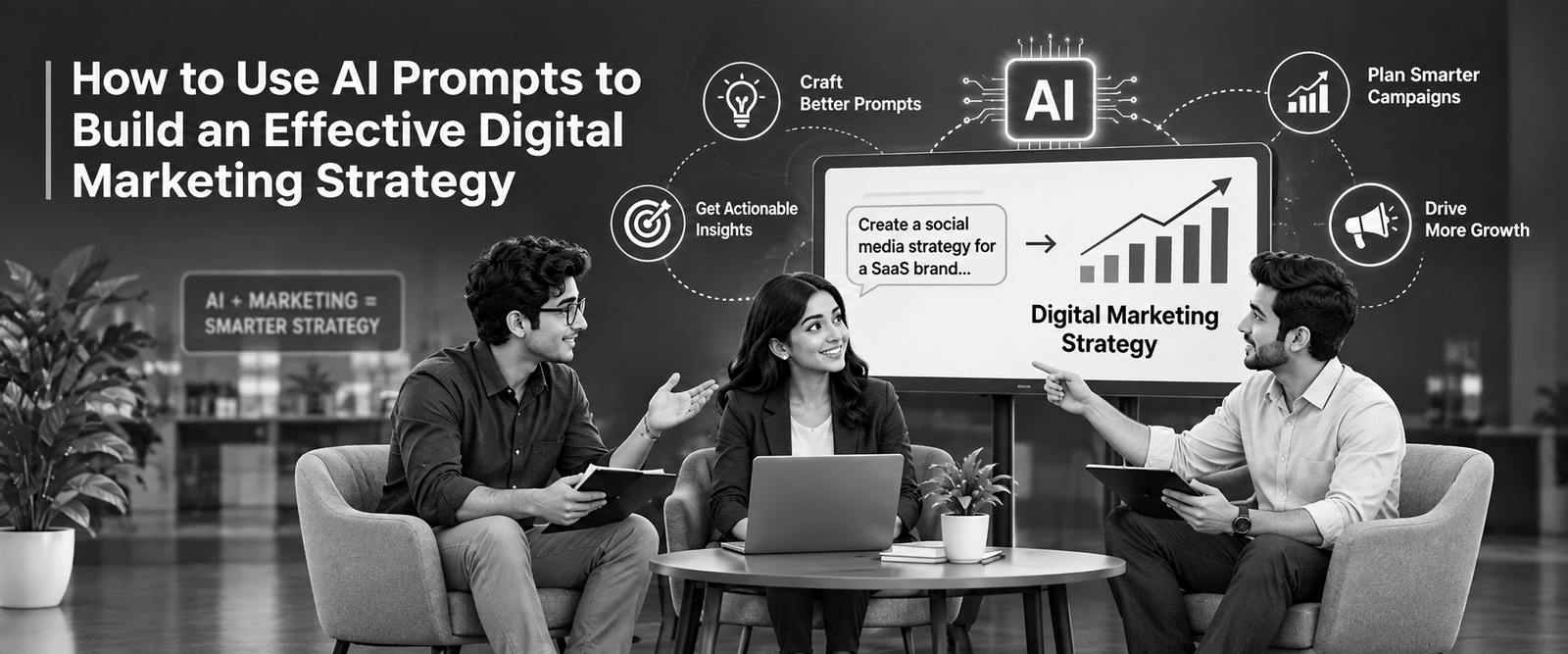
Using Artificial Intelligence (AI) in various sectors was once a theory and has now become a method. In digital marketing, AI can handle almost all the operations, from research to creating the required content, analysing customers, planning the campaigns, and tracking results. AI tools have played a key role in generating essential information. Prompts help generate new ideas, identify target customers, develop marketing strategies, and create the desired content. Tools also study customers, monitor their behaviour, identify market trends, and spot new opportunities.
If you think people can’t master digital marketing, you might be wrong. While AI saves us effort, it will not eliminate strategic thinking and professional knowledge. Behind every automated prompt, tool-generated insight, and marketing strategy is an experienced marketing consultant in Kerala.
Being this mastermind is what it takes to be on top of digital marketing today. How to do it? Keep reading this blog for practical ways to use AI prompts to build, implement, and improve a digital marketing strategy.
1. Understand How AI Prompts Work in Online Marketing
For this purpose, it’s essential to answer the following three questions: What are AI prompts? How is it possible to use AI prompts in marketing planning? How can the usage of tools like ChatGPT help marketers make the most of their marketing activities?
AI Prompts Explained
AI prompts are phrases, questions, or commands given to software to get specific information. They help us communicate with AI. When creating good prompts, it is very important to have a specific aim, provide enough information about your request, as well as guidelines for the expected result. The better the prompt, the better the output you are going to get.
How can they help companies with their marketing strategies?
There are three key points to be noted:
- Generating creative concepts for campaigns, defining the right market segment, and creating a content marketing plan.
- Making keyword procurement, competitor research, social media management, and copywriting tasks easier.
- Automating tedious marketing processes and optimizing the overall planning timeline.
What Advantages Can You Get When Using ChatGPT and Other AI Marketing Solutions?
These advantages include faster content production, greater effectiveness, creative assistance, audience insights, automation of routine activities, SEO and research assistance, multilingual and tonal adaptation, data analytics and prognosis, marketing campaign automation and testing, and channel execution.
But it is also necessary to keep in mind fact-checking, editorial work, and protecting sensitive data. Fact-checking is important because AI produces typical phrases, mistakes, and irrelevant information. To protect sensitive information, make sure you do not copy and paste customers’ information, proprietary data, and login credentials into OpenAI.
2. Using AI Prompts for Audience Research and Competitor Analysis
Here, AI understands customer needs and behaviour, identifies target audiences, analyses competitors and market trends, and creates customer personas.
To understand customer needs and behaviour, provide AI prompts that analyse customer preferences, pain points, buying habits, and common concerns. This helps to understand what influences the audience’s purchasing decisions.
AI can identify potential target audiences for focused and effective campaigns based on age, location, interests, industry, and purchasing behaviour.
Customer personas are created by organising audience research into detailed customer personas with demographics, goals, challenges, interests, and buying motivation. They help in developing more relevant marketing messages and campaigns.
3. Creating a Digital Marketing Strategy Using AI Prompts
Here, AI develops marketing goals and objectives, creates SEO and content marketing plans, and plans social media marketing campaigns. This aligns marketing objectives with overall business goals, creates content matching the search intent, and attracts their target audience.
5 Useful AI Prompts to Build a Digital Marketing Strategy
1. For Identifying Target Audiences – Act as a digital marketing strategist. Identify the ideal target audience for a [business type] operating in [location]. Include customer demographics, interests, pain points, online behaviour, and purchasing motivations. Suggest relevant audience segments for marketing campaigns.
2. Prompt for Competitor Analysis – Act as a competitor analysis expert. Analyse the digital marketing strategies of leading competitors in the [industry] sector. Identify their strengths, weaknesses, content strategies, SEO performance, social media presence, and potential gaps that my business can leverage.
3. For SEO Strategy Planning – Act as an SEO specialist. Develop an SEO strategy for a [business type] targeting customers in [location]. Suggest primary and secondary keywords, search intent, content topics, on-page SEO improvements, and link-building opportunities to improve organic visibility.
4. For Social Media Content Planning – Act as a social media marketing strategist. Create a 30-day social media content calendar for a [business type]. Include platform-specific content ideas for Instagram, Facebook, and LinkedIn, along with post formats, captions, creative concepts, hashtags, and suitable CTAs.
5. For Developing a Complete Marketing Strategy – Act as an experienced digital marketing consultant. Develop a comprehensive digital marketing strategy for a [business type] with the goal of [business objective]. Include target audience research, competitor analysis, SEO, content marketing, social media, paid advertising, budget allocation, KPIs, and a 90-day implementation roadmap.
4. Measuring and Improving Marketing Performance with AI
AI tracks digital marketing campaign performance, analyses website traffic and customer engagement, identifies areas for marketing improvement, and optimises marketing strategies.
AI-powered tools monitor metrics such as clicks, conversions, impressions, and engagement levels to track digital marketing campaign performance. This gives you insight into which campaigns are performing well and which need improvement.
To analyse website traffic and customer engagement, AI analyses website visits, user behaviour, browsing patterns, and engagement levels. These insights help you understand customer interests and how visitors interact with your content.
AI marketing analytics identify underperforming campaigns, ineffective channels, audience gaps, and content for marketing improvement, and address issues before they affect overall marketing results.
AI-generated insights optimise marketing strategies by refining audience targeting, adjusting campaign budgets, improving content, and selecting effective marketing channels. This enhances your data-driven decisions and marketing ROI.
Conclusion – Build a Smarter Digital Marketing Strategy with AI
AI prompts make digital marketing planning more efficient by supporting audience research, competitor analysis, content creation, and performance tracking. However, successful implementation requires strategic thinking and continuous optimisation. Working with an experienced Marketing Consultant in Kerala can help businesses turn AI-powered insights into effective marketing strategies. Connect with Nijoe Varkey for professional digital marketing consultation and sustainable business growth.